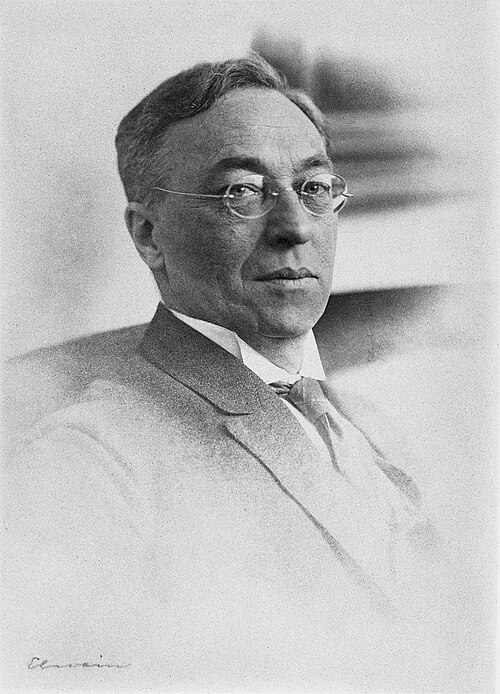
Wassily Wassilyevich Kandinsky (16 December [O.S. 4 December] 1866 – 13 December 1944) was a Russian painter and art theorist active in Germany during the late Belle Époque and Interwar eras. Kandinsky is generally credited as one of the pioneers of abstraction in Western art. Born in Moscow, he began painting studies (life-drawing, sketching and anatomy) at the age of 30.
In 1896, Kandinsky settled in Munich, studying first at Anton Ažbe's private school and then at the Academy of Fine Arts. During this time, he was first the teacher and then the partner of German artist Gabriele Münter. He returned to Moscow in 1914 after the outbreak of World War I. Following the Russian Revolution, Kandinsky "became an insider in the cultural administration of Anatoly Lunacharsky" and helped establish the Museum of the Culture of Painting. However, by then, "his spiritual outlook... was foreign to the argumentative materialism of Soviet society" and opportunities beckoned in Germany, to which he returned in 1920. There, he taught at the Bauhaus school of art and architecture from 1922 until the Nazis closed it in 1933. He then moved to France, where he lived for the rest of his life, becoming a French citizen in 1939 and producing some of his most prominent art. He died in Neuilly-sur-Seine in 1944.
Kandinsky was born in Moscow, the son of Lidia Ticheeva and Vassily Silvestrovich Kandinsky, a tea merchant.[4][5] One of his great-grandmothers was Princess Gantimurova.[6] Kandinsky learned from a variety of sources while in Moscow. He studied many fields while in school, including law and economics. Later in life, he would recall being fascinated and stimulated by colour as a child. His fascination with colour symbolism and psychology continued as he grew.
In 1889, at age 23, he was part of an ethnographic research group that travelled to the Vologda region north of Moscow. In Looks on the Past, he relates that the houses and churches were decorated with such shimmering colours that upon entering them, he felt that he was moving into a painting. This experience, as well as his study of the region's folk art (particularly the use of bright colours on a dark background), were reflected in much of his early work.
A few years later, he first likened painting to composing music in the manner for which he would become noted, writing "Colour is the keyboard, the eyes are the harmony, the soul is the piano with many strings. The artist is the hand which plays, touching one key or another, to cause vibrations in the soul".
Kandinsky was also the uncle of Russian-French philosopher Alexandre Kojève (1902–1968).